
B2B buying has grown more complicated. Deals rarely rest on a single decision-maker anymore. Most purchases now move through buying committees of six to ten stakeholders, each weighing different priorities and asking different questions. When that back-and-forth happens across email threads, shared drives, spreadsheets, and disconnected CRM records, deals stall and context gets lost.
That’s the gap Digital Sales Rooms (DSRs) are built to close. A DSR gives buyers and sellers one secure, shared workspace to run the deal from: proposals, meeting recordings, mutual action plans, contracts, and ongoing communication, all in a single place instead of scattered across a dozen tools.
The category has grown quickly, and vendors have started to specialize. Some platforms lean into buyer experience and design. Others focus on proposals and e-signatures. A newer group extends the workspace past the signature, into onboarding and customer success.
To help narrow the field, we evaluated the leading DSR platforms on product depth, AI capability, CRM integration, buyer collaboration tools, and how each is rated by actual customers.
What Is a Digital Sales Room?
A Digital Sales Room is a secure, shared online workspace where buyers and sellers collaborate for the length of the sales process, and increasingly, beyond it. Rather than juggling separate tools for proposals, scheduling, and file sharing, a DSR pulls it all into one buyer-facing hub.
Most platforms in this category include:
- Proposal and document sharing
- Mutual action plans
- Two-way buyer and seller collaboration
- Meeting recordings and notes
- Engagement analytics
- CRM synchronization
- E-signatures
- Content tracking
The key difference from a plain proposal tool is persistence. A DSR stays active for the life of the deal, and in some cases through onboarding, rather than disappearing once a document is sent.
How We Ranked These Platforms
Rankings reflect a mix of:
- Product capabilities
- AI functionality
- Buyer collaboration features
- Depth of CRM integration
- Mutual Action Plan (MAP) tools
- Continuity from sales into onboarding
- G2 ratings and customer feedback
- Overall fit for modern B2B sales teams
We weighted AI depth and sales-to-onboarding continuity more heavily than G2 score alone, since these are the areas where DSR platforms are differentiating fastest and where they create the most long-term value for revenue teams. A platform with a slightly lower rating but stronger continuity or AI capability can rank above one with a marginally higher score but narrower functionality.
Rather than ranking by popularity alone, we weighed which platforms deliver the strongest buyer experience and the most durable long-term value.
1. Trumpet: Best for Interactive Buyer Experiences
Verified G2 Rating: 4.7/5
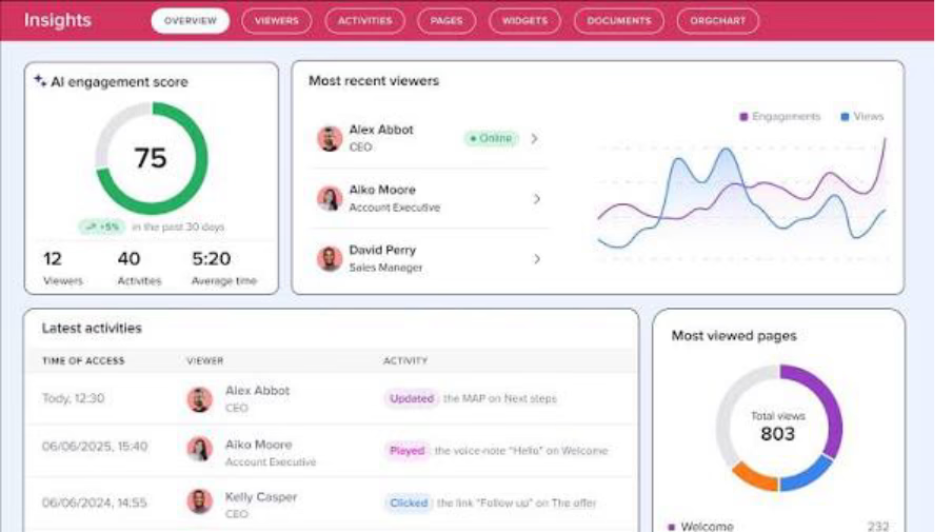
Trumpet has built a strong reputation around Pods, highly visual, branded buyer workspaces that sales teams can spin up without any design background. That combination of polish and speed has made it a favorite among SaaS companies that treat buyer experience as a competitive edge.
Its AI goes beyond basic automation. Trumpet reads stakeholder engagement patterns, drafts executive summaries, and flags deals that show early signs of going cold through built-in deal health scoring. Paired with solid Salesforce and HubSpot integrations, it gives reps a clear window into what buyers are doing inside the room.
Strengths
- Polished, highly customizable buyer workspaces
- AI-driven deal health scoring
- Stakeholder-level engagement tracking
- Strong Salesforce and HubSpot integrations
- Quick room setup with reusable templates
- Consistently strong buyer experience
Limitations
- No native commerce functionality
- CPQ requires third-party integration
- Post-sale onboarding support is limited
Pricing: Trumpet uses tiered per-user pricing: Free (10 sales rooms, unlimited users), Pro $45/user/month, Scale $100/user/month, and Elite $160/user/month (sales-assisted). Annual billing shown is $450/$1,000/$1,600 per user/year respectively.
Best for: SaaS and enterprise sales teams that want a branded, high-visibility buyer experience.
2. Projetly: Best for AI-Powered Sales-to-Onboarding Continuity
Verified G2 Rating: 4.8/5
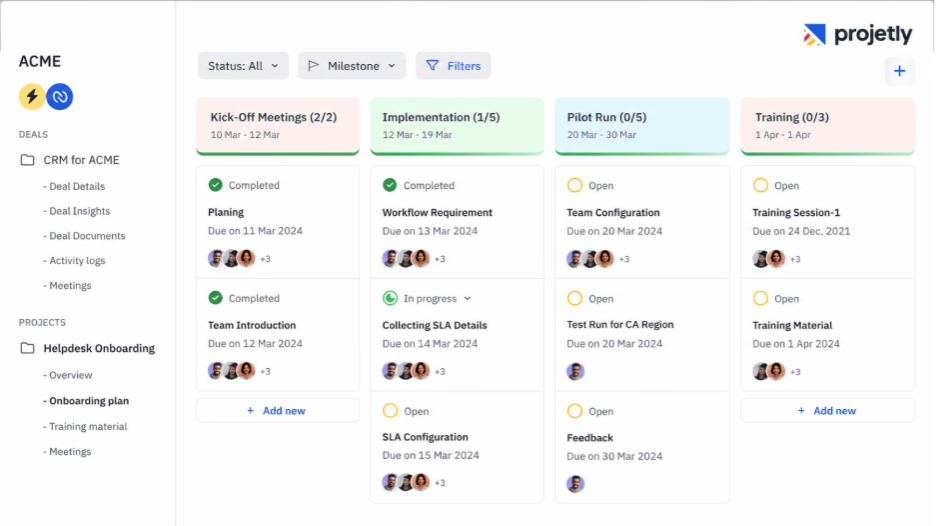
Most DSRs stop at Closed Won. Projetly is built around the idea that the handoff after signature is just as important as the deal itself, connecting sales, onboarding, and delivery into one continuous workflow instead of three separate tools.
When a deal closes, Projetly automatically carries meeting notes, documents, stakeholder info, tasks, and milestones forward into onboarding, cutting down the manual re-entry that usually slows implementation teams down.
On the AI side, the platform records and summarizes meetings, pulls out action items, and suggests follow-up tasks. Engagement analytics show which stakeholders are actually active and where a deal might be losing steam. The platform rounds this out with Mutual Action Plans, stakeholder mapping, org charts, native e-signatures, sales playbooks, and AI agents that support the full arc from sales through delivery.
Strengths
- AI-powered meeting intelligence
- Automated handoff from sales to onboarding
- Stakeholder engagement analytics
- Mutual Action Plans and buyer collaboration tools
- Native e-signatures
- Built-in sales playbooks
- AI agents spanning sales, onboarding, and delivery
- Responsive support and fast implementation
Limitations
- Reporting and dashboards are still maturing
- Fewer third-party integrations than larger platforms
- Best suited to complex deals rather than simple transactional sales
Pricing: Starter is $19/user/month, Growth is $49/user/month, and Enterprise is $99/user/month. A free trial is available.
Best for: Mid-market and enterprise teams in SaaS, consulting, and professional services managing multi-stakeholder deals with real onboarding requirements.
3. Aligned: Best for AI-Powered Buyer Collaboration
Verified G2 Rating: 4.7/5
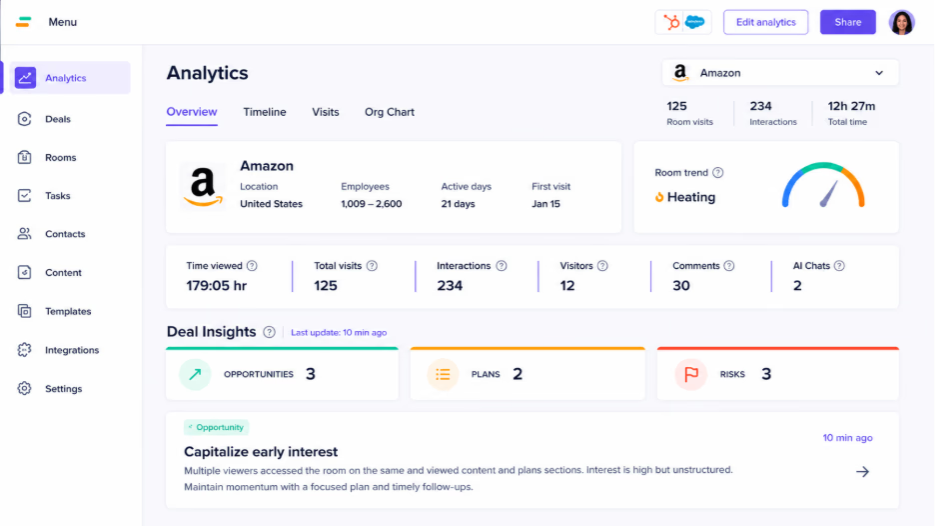
Aligned is designed around a simple premise: make enterprise buying easier, not just selling easier. Instead of acting as a document repository, it provides a collaborative workspace where every stakeholder can find relevant content, track progress, and stay on the same page.
AI is woven throughout, generating deal rooms, suggesting next steps, drafting proposals, and surfacing buyer insight. Combined with deep, bidirectional Salesforce and HubSpot integration, it gives sales teams real visibility into engagement while cutting down manual admin work. Its Mutual Action Plan experience is among the strongest in the category, which makes it a natural fit for larger buying committees.
Strengths
- AI-generated deal rooms and content
- Strong buyer collaboration experience
- Advanced stakeholder engagement analytics
- Deep Salesforce and HubSpot integration
- Strong Mutual Action Plans
- Automated room creation
Limitations
- Focused mainly on pre-sale workflows
- No native onboarding continuity
- Limited proposal and contract management
- Better suited to collaborative selling than post-sale delivery
Pricing: A free Starter plan is available. Basic runs about $29 to $35/seat/month, Pro is about $60/seat/month, and Enterprise is custom priced.
Best for: Teams managing complex buying committees that want AI support throughout the sales cycle.
4. Accord: Best for Mutual Action Plans and Sales Process Standardization
Verified G2 Rating: 4.9/5
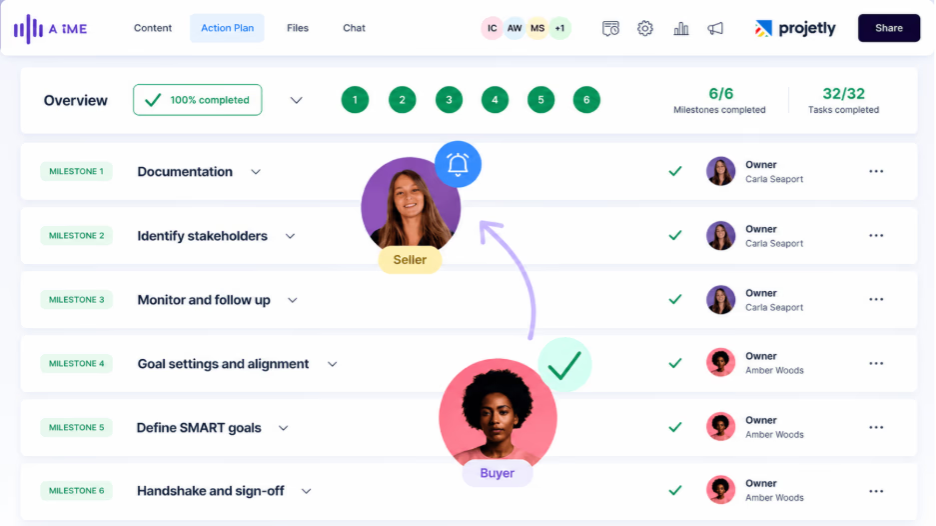
Accord takes a process-first approach to the DSR category. Rather than leading with visual design, it helps revenue teams standardize how deals move forward using structured playbooks, AI-assisted account research, stakeholder mapping, and collaborative Mutual Action Plans.
The platform gives leadership visibility into how deals are progressing across regions, products, and segments, while AI handles account research, executive summaries, and methodology adherence. That makes it especially useful for organizations running established frameworks like MEDDPICC or Challenger.
Strengths
- Excellent Mutual Action Plans
- AI-powered account research
- Standardized sales playbooks
- Strong CRM synchronization
- Consistent execution across teams
- Leadership-level pipeline visibility
Limitations
- More process-oriented than experience-oriented
- Less visual customization than some competitors
- Learning curve for teams without a defined sales methodology
- Limited post-sale functionality
Pricing: The Starter plan is $99/user/month plus a platform fee, and Growth is $119/user/month plus a platform fee. Enterprise is custom priced.
Best for: Enterprise sales organizations standardizing execution across large revenue teams.
5. Dock: Best for Sales-to-Customer Success Handoff
Verified G2 Rating: 4.6/5
Dock has found a strong niche among B2B SaaS companies that treat onboarding as a continuation of the sales process rather than a separate stage. Instead of spinning up a new workspace after signature, Dock carries the same shared space through implementation.
Native Salesforce and HubSpot integrations keep deal data in sync, while proposals, videos, documentation, and onboarding tasks all stay in one place. Its AI features are still developing, but the platform continues to add automation aimed at reducing friction between sales and customer success.
Strengths
- One continuous workspace from sales through onboarding
- Strong Salesforce and HubSpot integrations
- Configurable workflows
- Proposal and video support
- Familiar interface for customer success teams
Limitations
- AI functionality still in beta
- No native CPQ
- Limited commerce capabilities
- Templates require upfront setup effort
Pricing: Dock uses flat platform fees, not per-seat pricing: Free ($0 forever), Standard ($350/month), and Premium ($1,000/month, billed annually). Enterprise is custom, via annual contract.
Best for: B2B SaaS companies with structured onboarding and dedicated customer success teams.
6. GetAccept: Best for Proposal and E-Signature Workflows
Verified G2 Rating: 4.6/5
GetAccept bundles Digital Sales Rooms, proposal generation, document tracking, live chat, video messaging, and native e-signatures into a single platform. Its clearest strength is streamlining the path from proposal to signature, with integrations spanning Salesforce, HubSpot, Microsoft Dynamics, Pipedrive, and Upsales.
Its AI leans toward proposal creation, content personalization, meeting summaries, and transcript analysis, rather than broader buyer intelligence. That makes it a strong fit for teams handling high proposal volume who want to consolidate tools.
Strengths
- Native e-signatures
- Strong proposal automation
- Broad CRM integration support
- AI-generated content recommendations
- Live document collaboration
- Clear visibility into buyer engagement
Limitations
- Limited onboarding capabilities
- Less emphasis on stakeholder analytics
- AI mostly supports proposal workflows
- Better suited to document-heavy sales motions
Pricing: The eSign plan starts at $25/user/month, and the Professional plan is $49/user/month. Enterprise is custom priced. No free plan is offered, but a free trial is available.
Best for: Revenue teams managing high proposal volume across multiple CRMs.
7. Flowla: Best for AI Workflow Automation
Flowla’s differentiator is automation. Rather than treating the DSR as a static portal, it structures every deal as a guided buyer journey with auto Instead of treating the DSR as a static portal, it guides each deal through a buyer journey. It uses automated follow-ups, trigger-based actions, and configurable AI agents. mated follow-ups, trigger-based actions, and configurable AI agents.
Its Mutual Action Plans can be displayed as task lists, Kanban boards, or Gantt charts, and AI agents handle routine activity before routing it back for human approval, a setup that appeals to growing teams trying to scale without adding headcount.
Strengths
- AI-powered workflow automation
- Custom AI agents
- Flexible Mutual Action Plans
- Fast deployment
- Human-in-the-loop AI review
- Strong automation for lean teams
Limitations
- Enterprise adoption still relatively limited
- Advanced customization has a learning curve
- E-signature capabilities less mature
- Better fit for SMB and mid-market than large enterprise
Pricing: A free Starter plan is available with 5 deal rooms and unlimited seats. Pro is $49/user/month, and Team is $79/user/month with AI agents and workflow automation included. Enterprise is custom priced.
Best for: Growing sales teams that want AI to absorb administrative work while keeping buyers engaged.
Comparison Table
| Platform | G2 Rating | Key Strength | AI Capabilities | CRM Integration | Sales-to-Onboarding |
| Trumpet | 4.7/5 | Branded buyer experiences | Deal health scoring, executive summaries | Salesforce HubSpot | No |
| Projetly | 4.8/5 | AI-powered sales and onboarding | Meeting intelligence, AI agents, stakeholder analytics | Salesforce, Outlook | Yes |
| Aligned | 4.7/5 | Buyer collaboration | AI room generation, content creation | Salesforce, HubSpot | No |
| Accord | 4.9/5 | Mutual Action Plans | AI research and playbooks | Bidirectional CRM sync | Partial |
| Dock | 4.6/5 | Customer onboarding continuity | AI workflow automation (Beta) | Salesforce, HubSpot | Yes |
| GetAccept | 4.6/5 | Proposals and e-signatures | AI proposal generation, transcript insights | Multiple CRMs | No |
| Flowla | 4.9/5 | Workflow automation | Custom AI agents | CRM integrations | No |
How to Choose the Right Digital Sales Room
Most digital sales room software look similar to a feature checklist. In practice, adoption usually comes down to three questions.
- Will buyers actually use it? A clean, well-organized room with personalized content and no login barrier will usually beat a feature-heavy platform that feels like one more enterprise portal to manage.
- How deep is the CRM sync? Look for bidirectional synchronization, so engagement data, tasks, and updates flow automatically between the DSR and your CRM rather than requiring manual updates on either side.
- Does it match your sales motion? Proposal-heavy teams need strong document workflows. Enterprise teams need stakeholder collaboration and MAPs. Organizations with long implementations need onboarding continuity built in, not bolted on.
A Simple Decision Framework
| If you want… | Consider… | Focus area |
| Best buyer experience | Trumpet | Design-first |
| Best sales-to-onboarding continuity | Projetly | End-to-end |
| Best for enterprise buying committees | Aligned | Collaboration |
| Best for standardized sales execution | Accord | Process |
| Best for proposals and e-signatures | GetAccept | Document flow |
| Best for AI workflow automation | Flowla | Automation |
Final Verdict
If overall buyer experience is the priority, Trumpet remains the strongest option. Its branded workspaces, stakeholder-level analytics, and polished interface make it easy for buyers to adopt without friction.
Projetly takes the number two spot for tackling a problem most DSR vendors leave alone: what happens after the contract is signed. By pairing AI-driven deal execution with an automated handoff into onboarding, it removes one of the more persistent sources of friction in enterprise B2B sales.
For teams with different priorities:
- Aligned: best for complex, multi-stakeholder enterprise deals
- Accord: best for standardizing sales execution and Mutual Action Plans
- Dock: best for SaaS companies focused on onboarding continuity
- GetAccept: best for proposal-heavy sales organizations
- Flowla: best for growing teams that want AI-driven workflow automation
Most vendors offer free trials or guided demos. The most reliable way to decide is to run one real opportunity through two shortlisted platforms and compare buyer engagement, rep adoption, and the quality of the handoff into onboarding.
Frequently Asked Questions
- What’s the difference between a Digital Sales Room and a proposal tool?
A proposal tool generates and sends a single document. A Digital Sales Room is a persistent buyer workspace that includes proposals, documents, meeting recordings, mutual action plans, collaboration tools, analytics, and often e-signatures.
- Which DSR is best for small sales teams?
Flowla and Aligned are the fastest to deploy and require the least administrative overhead, making them a good fit for teams under 100 users.
- Which platform has the strongest AI capabilities?
For end-to-end AI, Projetly is a strong leader; for AI-assisted deal execution and collaboration, Aligned is the top specialist.
- Do all DSRs integrate with Salesforce and HubSpot?
Most major platforms support both, but integration depth varies significantly. Always confirm whether the sync is bidirectional and whether engagement data flows back into the CRM automatically.
- When is a Digital Sales Room worth the investment?
DSRs tend to deliver the strongest ROI on multi-stakeholder B2B deals, sales cycles longer than 30 days, and contracts above roughly $20K ACV. For simple, transactional sales, the setup effort may not be worth it.
