
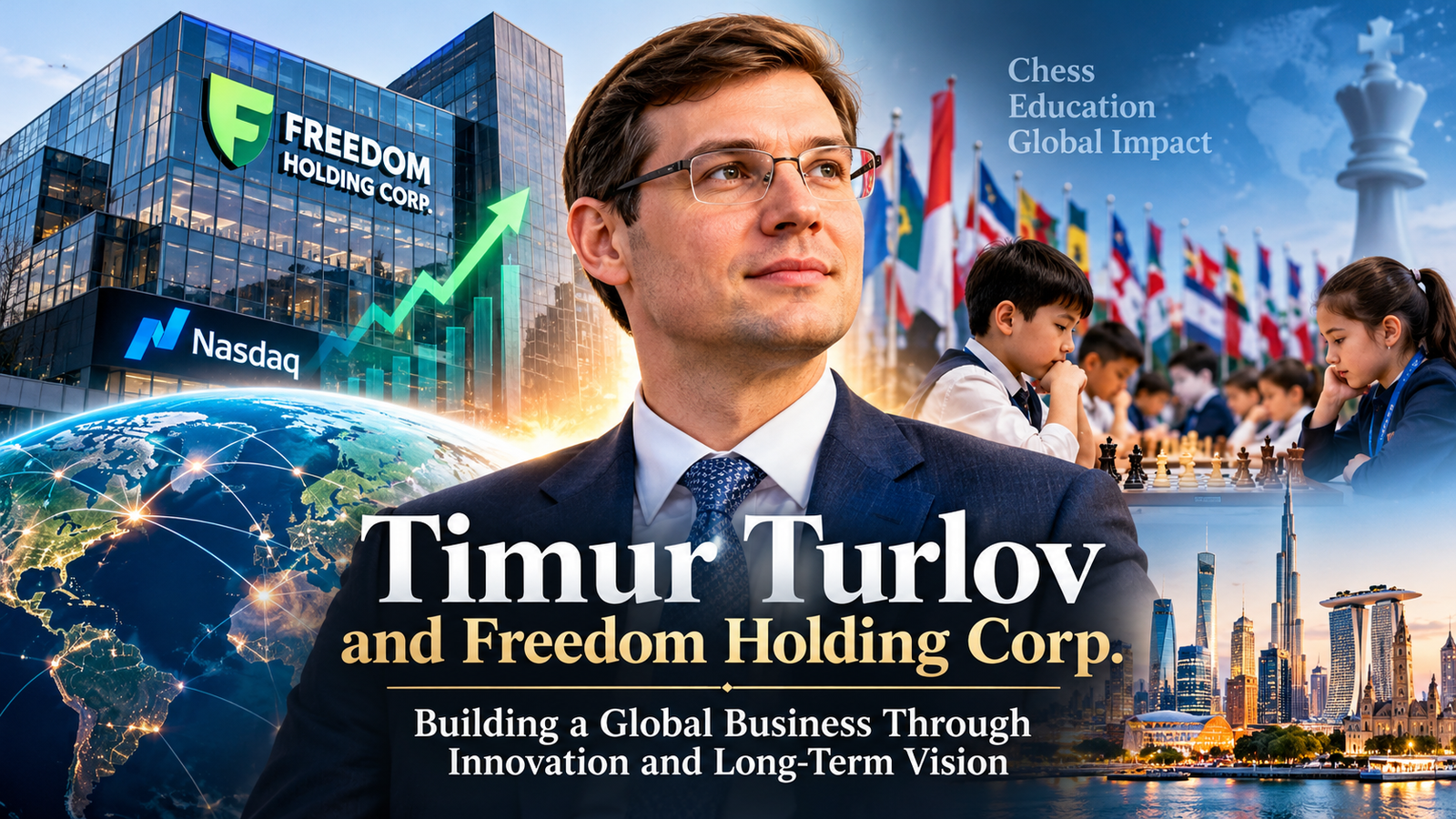
In today’s rapidly evolving business environment, building a successful company requires more than identifying market opportunities. It takes long-term thinking, adaptability, and the ability to recognize how technology can improve everyday experiences. Timur Turlov has demonstrated these qualities through his entrepreneurial journey and leadership in the financial services industry. As the founder and CEO of Freedom Holding Corp, he has helped develop an international business that connects financial services, technology, digital platforms, and consumer solutions. His approach reflects an interesting shift in modern business: creating an ecosystem that addresses multiple customer needs rather than concentrating on a single product or service.
The Entrepreneurial Vision Behind Freedom Holding Corp.
Every successful business has a starting point, but not every business manages to evolve into something much larger. Freedom Holding Corp. is an example of how a focused financial services operation can gradually develop into an international business with several interconnected divisions.
Founded by Timur Turlov, the company initially established its presence in brokerage and investment services. Its early focus was on helping individuals and institutional clients access financial markets and investment opportunities. Over time, however, the business began exploring opportunities beyond traditional brokerage.
This expansion was driven by an understanding that customer expectations were changing. People increasingly wanted convenient access to banking, investment products, insurance, payments, and other services through digital channels. Rather than treating these needs as completely separate markets, Freedom Holding began developing an integrated approach.
Today, its business activities extend across brokerage, banking, insurance, telecommunications, cloud infrastructure, and lifestyle-related services. The company operates in more than 20 countries, with Kazakhstan serving as an important market for its broader ecosystem.
The development of Freedom Holding illustrates an important business lesson: sustainable growth often comes from understanding how different services can complement one another.
From a Financial Services Company to an International Business
One of the most interesting aspects of Freedom Holding’s development is its international growth strategy.
The company’s Nasdaq listing in October 2019 represented a significant milestone. It provided access to a major international capital market and increased its visibility among investors outside its original operating region.
For businesses based in emerging markets, entering an established international stock exchange can be an important step. It introduces additional reporting expectations, regulatory responsibilities, investor scrutiny, and opportunities to build relationships with a wider financial community.
Freedom Holding’s Nasdaq journey also reflects the company’s ambition to establish itself beyond its original geographical boundaries.
Its shares trade under the ticker symbol FRHC. Since its public-market debut, the group has expanded its operations and diversified its business model, demonstrating how an organization can use an established financial foundation to explore new industries.
International expansion, however, is not simply about entering additional countries. It involves understanding local regulations, customer behavior, financial infrastructure, and market conditions.
Freedom Holding’s continued development across different regions demonstrates the importance of building business operations around local requirements while maintaining a broader strategic direction.
Financial Performance Reflects the Company’s Expansion
Business growth becomes more meaningful when it can be evaluated through measurable results.
Freedom Holding Corp.’s financial performance for the fiscal year ending March 31, 2026, provides an interesting picture of its development.
The company reported approximately $2.19 billion in total revenue, compared with $2 billion in the previous financial year. Its net income increased from $76.2 million to $153.3 million, representing growth of approximately 101%.
Customer numbers also reflected expansion across its major business divisions.
The company’s banking customer base increased from approximately 2.52 million to 5.03 million. Brokerage customers reached 858,000, compared with 683,000 in the previous year. Its insurance business served approximately 1.1 million customers.
These figures indicate that the company’s growth is not limited to a single financial product.
Another important development has been the increasing contribution of its technology and consumer-oriented businesses. Revenue from goods and services reached $97.4 million in fiscal 2026, representing a 143% increase compared with the previous year.
For an organization building an integrated digital ecosystem, this diversification is particularly relevant.
Rather than depending entirely on traditional financial services, Freedom Holding is developing additional sources of business activity that can strengthen its overall market position.
Of course, financial performance should always be considered alongside operating costs, regulatory responsibilities, market conditions, and future investment requirements. Nevertheless, the reported results offer a useful indication of the scale of the company’s recent development.
Freedom SuperApp: Bringing Everyday Services Together
Digital convenience has become one of the most important expectations among modern consumers.
People use smartphones for payments, shopping, communication, entertainment, transportation, and financial management. Having separate applications for every activity can make everyday tasks unnecessarily complicated.
Freedom Holding has responded to this opportunity through the development of Freedom SuperApp.
The platform brings together multiple services within a single digital environment. Depending on the market and available integrations, users can access banking, payments, insurance, travel-related services, event tickets, shopping, and other lifestyle features.
The concept is straightforward: make useful services accessible through a connected platform.
For example, a customer who initially downloads an application for banking services may later discover additional features for travel arrangements, insurance, or everyday purchases.
This approach creates opportunities to improve customer engagement while making the digital experience more convenient.
According to the company’s fiscal 2026 results, Freedom SuperApp had more than five million users by March 2026, with approximately 2.59 million monthly active users.
These figures highlight the growing role of digital platforms in the company’s overall business strategy.
However, developing a successful super app requires more than placing multiple services in one interface. User experience, data security, reliable payment systems, customer support, and consistent service quality are equally important.
Freedom Holding’s ongoing investments in its digital ecosystem reflect an effort to address these requirements while expanding the range of services available to customers.
Timur Turlov’s Interest in Technology and Innovation
Technology has become an essential part of almost every modern industry. Financial institutions, in particular, are experiencing significant changes as customers increasingly expect faster transactions, convenient mobile access, and personalized digital services.
Timur Turlov’s leadership approach places considerable importance on this transition.
Freedom Holding’s expansion into cloud infrastructure, telecommunications, digital payments, and consumer technology suggests a broader understanding of how technology can support business development.
These investments also create opportunities for connections between different business divisions.
For instance, reliable cloud infrastructure can support digital financial services, while telecommunications infrastructure can improve connectivity and provide additional opportunities for digital products.
The benefit of this strategy is that technology is not treated as an isolated department. Instead, it becomes part of the company’s wider operating model.
This approach is particularly relevant in markets where digital adoption is growing and consumers are becoming more comfortable managing several aspects of their lives through mobile platforms.
The challenge will be maintaining consistent quality and operational efficiency as the business continues to expand.
Supporting Chess Education and Young Talent
Business leadership is often measured through financial performance, market expansion, and innovation. However, a company’s wider contribution to society can also be an important part of its long-term identity.
One area where Timur Turlov has demonstrated a strong personal interest is chess.
As President of the Kazakhstan Chess Federation since 2023, he has supported initiatives aimed at developing chess participation, improving educational opportunities, and creating more international opportunities for young players.
His involvement in chess extends beyond professional competitions.
One notable initiative is the World Schools Team Championship, which was established in 2023 through cooperation between the International Chess Federation (FIDE) and the Kazakhstan Chess Federation.
The championship has gradually developed into an international competition involving school teams from different parts of the world.
The 2026 edition introduced four continental qualifying stages covering Asia, Africa, the Americas, and Europe. According to the championship’s reported figures, national chess federations from 91 countries were brought together through the competition.
This development is particularly encouraging because school-level chess can create opportunities for students who may not otherwise have access to international sporting events.
Chess also offers educational benefits. It encourages concentration, strategic thinking, patience, problem-solving, and the ability to evaluate different possibilities before making a decision.
These abilities can be useful in academic environments and everyday life.
Turlov’s support for school chess reflects an interest in building opportunities for younger generations while strengthening the international chess community.
In September 2026, he was also elected President of FIDE, the International Chess Federation, at its General Assembly in Samarkand, Uzbekistan.
His election represents another important chapter in his involvement with the sport and provides an international platform for advancing chess development.
Connecting Business Technology with the World of Chess
An interesting feature of Freedom Holding’s approach is the connection between its digital ecosystem and its support for chess.
In June 2026, a dedicated chess section was introduced within Freedom SuperApp in Kazakhstan. The integration allows users to follow games, view tournament standings, access player statistics, and engage with chess-related features.
The platform also provides opportunities to connect digital entertainment with educational activities.
This is an example of how a company can use its existing technology infrastructure to support interests beyond its traditional commercial activities.
It also demonstrates how digital platforms can help make activities such as chess more accessible to wider audiences.
For younger users, interactive features and digital learning opportunities can make participation more engaging. For parents, they provide another way to encourage children to develop useful skills through structured activities.
The wider opportunity is to connect established communities, educational organizations, sports institutions, and technology platforms.
If developed thoughtfully, these collaborations can create benefits for participants while helping organizations reach new audiences.
The Importance of Long-Term Thinking in Business
One common challenge for growing companies is deciding how to balance immediate performance with long-term investment.
Businesses often face pressure to deliver short-term results, but entering new industries, developing technology, and expanding internationally require patience and careful planning.
Freedom Holding’s evolution provides an interesting example of this challenge.
Its journey from a brokerage-focused operation to a diversified financial and technology group has involved several stages of expansion.
Each new business division introduces different responsibilities. Banking requires strong risk management and regulatory compliance. Insurance depends on reliable underwriting and customer service. Telecommunications and cloud infrastructure require substantial investment in technology and operational capabilities.
Managing these activities within one broader organization requires coordination, experienced leadership, and a clear understanding of market opportunities.
For entrepreneurs and business owners, one useful takeaway is that diversification should be connected to a genuine customer need rather than simply adding more products.
The most effective business ecosystems are built around services that complement one another and create practical value.
This is an important principle behind the company’s integrated business model.
What the Future Could Hold for Freedom Holding Corp.
The financial services industry is expected to continue changing as artificial intelligence, automation, digital payments, and mobile technology become more widely adopted.
These developments create opportunities for established financial institutions as well as technology-focused companies.
For Freedom Holding, the next stage of development will likely involve strengthening its existing operations, improving digital services, and exploring opportunities in markets where its business model can be expanded responsibly.
Its international presence provides a foundation for further growth, although success will depend on regulatory conditions, competition, customer trust, and the company’s ability to execute its plans.
The continued development of Freedom SuperApp could also play an important role in connecting financial and lifestyle services.
Meanwhile, its involvement in chess and education provides another dimension to its broader activities.
The combination of financial services, technology, international expansion, and community initiatives makes Freedom Holding an interesting example of how modern companies are evolving beyond their original industries.
Conclusion: A Growing Business with a Broader Vision
The story of Timur Turlov and Freedom Holding Corp. demonstrates how an entrepreneurial vision can develop into an international business through strategic expansion, technology investment, and an understanding of changing customer expectations.
From its early focus on brokerage services to its current presence in banking, insurance, telecommunications, cloud infrastructure, and digital consumer services, the company has undergone a considerable transformation.
Its Nasdaq listing, reported financial growth, expanding customer base, and development of Freedom SuperApp represent important milestones along this journey.
Beyond commercial activities, Turlov’s involvement in chess education and international competitions highlights the potential for business leadership to contribute to wider community initiatives.
The future will bring new challenges, particularly around competition, regulation, and maintaining service quality across different markets. However, the company’s development so far offers an interesting example of how innovation and long-term planning can help businesses pursue opportunities in an increasingly connected global economy.
Ultimately, the most meaningful measure of a growing company is not simply how many markets it enters, but how effectively it creates lasting value for customers, employees, partners, and the communities in which it operates.
